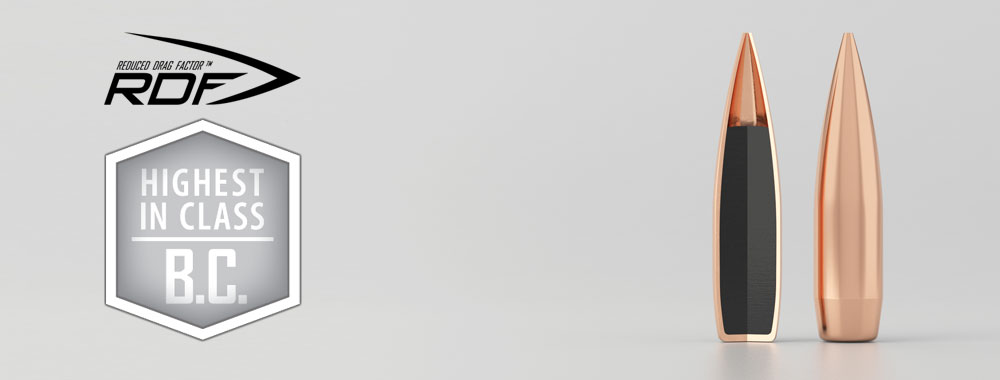
New 6.5 Creedmoor Bullet designs Edging Out .270 Winchester Performance?

Need a long range bullet that operates at all ranges? Both Nosler’s 142g Long Range AccuBond™ and Hornady’s Precision Hunter™ 143g ELD-X™ in 6.5 Creedmoor have come up with bullet Long Range designs that edge out the .270 Winchester bullets even though the .270 spitzer bullet is a bit faster at the muzzle. No we aren’t talking leaps here just that the 6.5 is better at delivered energy, bullet drop and wind deflection and yes sectional density, the key to penetration. For a given diameter science has added 10 grains to the oft touted .270 in 130 grain bullet for better sectional density at 140 grains. Does it matter much? Not hugely but it is a numbers game and it is about bullet construction and usefulness whether near or far and call it “all range hunting”. The ELD-X is said to hold its weight at close range by some folks and it is an interlock design. See the excellent article below from American Rifleman.org.

https://www.americanrifleman.org/articles/2015/12/21/tested-hornady-eld-x-bullet/ 

I am a big believer in the accuracy of the Hornady ELD-Xpanding however the Nosler AccuBond LR is bonded meaning the lead and copper are welded not just interlocked. I am a believer in Bonded bullets for game or all gilding copper as my Moose and Buffalo and deer attest, Particularly the Nosler AccuBond. Where this may matter is that Nosler’s LR AccuBond in close quarters, say 100 yards or less will perhaps hold on to more lead than the Hornady leaving less lead in your game at shorter ranges. Long range penetration by both bullets is controlled leaving most all of the bullets intact. Below is a You-Tube from a hunter that discusses penetration and how the AccuBond really holds tenaciously onto the lead.

It is like splitting hairs for some folks! Both Bullets are the very best in Long Range choices! For shorter ranges inside 100 yards, I am a Nosler AccuBond fan and I like the new gilding copper. See next article on Copper Bullets.

Get ready to hunt! Good Shooting!


F-Open Match Results 17-Jun-2017 with 6.5 Creedmoor by Jason Hale

I’m back to provide an update on the most recent 3×600 yard F-Open Match at Nashua Fish and Game.  This year I am doing a significant amount of testing, which doesn’t allow for getting truly comfortable with my set up, never the less, it was exciting.

To preface the discussion on results, I need to explain the challenges with the F-Open conversion to the Creedmoor barrel.  In preparation for the match and some practice time,  I changed out the barrel in my Savage 10 action to the Shilen 28″ stainless match 6.5 Creedmoor bull barrel.

Following the barrel swap, I installed the barreled action to my aluminum JPRifles AMCS chassis.  I was going to shooting in F-Class, Open, with the Nosler 140 gr 6.5mm/.264 Reduced Drag Factor ™ (RDF) bullets and due to the F-Class, open rules I could have a much heavier gun (22 lbs max).   That’s why I decided to move back to the heavier aluminum chassis.  The only downside was that when the rifle was mounted in the rest, I couldn’t use a rear bag that was a standard height.  I had to rig up a rear bag that was tall enough to be able to level the gun.  The PRS stock toe, is not as low as a true F-Open competition stock, but this isn’t a “built for competition” rig.  This is fun on a budget while learning to read the wind 🙂

I tuned my 6.5 loads easily with the Nosler RDF’s we are testing, getting 1/4 to 1/2″ groups while humming along comfortably at 2800 fps with 41.7gr of H4350.

RDF Bullet Banner

Very impressive, those RDF’s.  From my first experience with new gear, I was prepared with what to expect this time.  I was stayed focused and was pleasantly surprised, as the day went on I got better and better, despite the make shift gear.

As the day was not hot, I was able to keep the Leupold Gold Ring 7-42X55mm scope we are testing (seen above) dialed all the way to 42x and it was awesome to see the bull much more clearly and to use the target rings to aim for wind calls.

Here are my scores below for my first time in F-Open with new gear.

Match 1: 185-4

Match 2: 192-6

Match 3: 196-8

Final total: 573-18

The gun and Nosler 140 RDF’s were clearly shooting better than I in the beginning, but as I got the hang of the “free recoil” game, it all started to fall into place.  Free recoil is allowing the rifle to track rearward under recoil with some space in between you and the buttstock, very much like regular benchrest shooting.  I like F-Open, but for now, it’s just fun for me and a way to continue to learn the ways of the wind.  I think the only way to become more competitive in this class, you need first get better at wind reading and perhaps get a purpose built rifle/stock combination that was meant to be used in a rest.  I am more than happy with how this turned out.  I am super pleased with how the Nosler RDF’s were surprisingly easy to tune and shoot accurately!  I will be shooting this combination again July 8/9.

See you at the range!

© 2017

New Nosler RDF Bullet Initial Testing Begins by Jason Hale

In my previous article, I explained my intent with regards to load testing I wanted to complete in my current economy match rig, which is a Savage 10 repeater action, re-barreled with a Criterion 28” Stainless Select Match bull barrel chambered in .308 Winchester

Nosler supplied us with some brand spanking new .308 caliber 175 grain RDF bullets to review. Nosler intends to make this bullet a premier Competition bullet.

Quote from Nosler website

RDF Bullet – ( Reduced Drag Factor )

Flattest Shooting Match Bullet On The Market

For those wanting to squeeze the most performance from their competition rifle, Nosler’s new RDF (Reduced Drag Factor) match bullet line is the ideal choice. 

Nosler’s RDF line was designed from the ground up to provide exceptionally high BCs, which create the flattest trajectory and least wind drift possible. The keys to the RDF’s outstanding performance are Nosler’s meticulously optimized compound ogive and long, drag reducing boattail, which make handloading a snap and create an incredibly sleek form factor.  RDF bullets also have the smallest, most consistent meplats of any hollow point match bullet line, so there is no need to point or trim tips. 

Highest B.C.’s, smallest meplat, tighter groups – Nosler RDF.

Unquote


I was excited to see if the bullet would fit seamlessly into my current loading diet of Varget powder.  The accuracy results were pretty good, but at velocities that were a bit on the slow side unsurprisingly; great bullet, but as the data demonstrates, the bullet/powder combination choice may not be as accurate in my barrel.  I’m pretty sure that if I continue to experiment with powders that I would find one that would be extremely accurate with the Nosler RDF with my barrel.

175 Nosler RDF with Hodgdon’s Varget

Charge Weight Group Size Velocity
40.0 0.784” 2445
41.0 0.435” 2491
41.5 0.756” 2546
42.0 0.943” 2591
42.5 0.851” 2629

Bullet distance to rifling: 0.015”

Following this first test I decided to back off further from the rifling and at 0.045” off and way off loaded at mag length, and repeat some of the testing.

There was no discernible increase in accuracy. But what was missing here was speed! I needed a faster bullet to buck the wind. I an searching for a combination in my rifle to deliver a faster bullet too.

Testing with other powders is needed to fine tune the bullet and barrel combination and that is getting under way. Case in point, I had a bullet from another top manufacturer and was having a tough time getting sub-moa or better groups when I tried a certain powder it was like magic and the bullets grouped extremely well.


More to Come!

Selection and Testing of .308 Match Grade Bullets for F-TR Competition By Jason Hale

F-TR Rifle Competition is F-Class Competition where the TR is Target Rifle in .223 or .308 Winchester. At many matches, F-TR competitors are restricted to bi-pod, ruck or sandbags, though at the Nationals a front rest was allowed.

For me and what I’ve studied, its high mass high Ballistic Coefficient (BC) bullets that are most go-to projectiles (bullets).  You still have some folks shooting the 1:12 twist .308 Barrels that shoot between 155 gr and 175 gr projectiles, but mostly the heavy stuff.  Now at this point only one thing matters;

How does it perform with your chosen bullets IN YOUR GUN?  

My recently purchased 28” SS Criterion match barrel doesn’t seem to prefer the heavy 185 gr Berger’s, but I’ve only tried them with Varget, IMR 4064 is another option to try.  I like sticking with Varget since it works so well AND is more forgiving in variable temperatures.

If you’re just getting into competition shooting, you can’t go wrong with the 175 gr Sierra Match Kings.  You can load it to mag length. My factory barrel would shoot ¼” groups all day long.  The only downside is that when the wind is involved, it can get blown around quite a bit more than some of the other more recent slick BC offerings.  I am currently using the Sierra TMK’s and their shooting ½” at 100 yards and have a superior BC to the SMK.  So far I like them, but because the bullet profile is more secant, seating depth may be a hassle during tuning, but it didn’t take too long for me to find a depth that worked well and didn’t compress powder too much.

One item to point out, there is good reason that as a rule of thumb you don’t just try a new projectile which may be the same weight because if you seated them to the same length the depth into the case may change how compressed your charge is.  In addition, there are many other factors that are coming into play.  Spontaneous disassembly (BOOM) of your rifle and perhaps YOU is NOT GOOD.  It is wise to back off by 10% and then work back up while watching for signs of pressure.

Now for the true purpose behind this article, testing your loads.  Finding recommended loads out of a reputable loading manual is your job.  Here I will explain what I see in the data I’ve put together here.


The chart below represents testing and data gathered of bullets tested and corresponding results you may find of use.

Bullet Ballistic Coefficient Bullet OAL Base to Ogive COAL Seated to Lands Depth  Seated Into Case Previous Data/Comments
Berger 185 Juggernaut .283 G7 (Litz Verified) 1.342 0.698 2.923 0.424 Tried 1MOA best with Varget IMR 4064 an option
Sierra 175 Match King 0.495 G1 (averaged Sierra BC)

0.475 G1(Litz Verified)

0.243 G7 (Litz Verified)

1.230 0.661 2.838 0.397 2.800 (~0.040” off Lands)
Berger 168 Hybrid Target .264 G7

0.266 G7 (Litz Verified)

1.279 0.583 2.956 0.328 In Testing
Nosler 175 RDF .270 G7 1.330 0.651 2.950 0.385 In Testing
Sierra 175 TMK 0.523 G1

(Sierra BC)

0.522 G1 (Litz Verified)

0.267 G7

1.353 0.658 2.940 0.418 Current COAL 2.920 (0.020” off Lands)

Good groups 0.5 gr less than SMK due to pressure


Nosler 175 Comments/My Approach:

Looking at the Nosler 175 RDF’s you can clearly see that the tip is almost completely closed, which is awesome.  With Nosler’s claimed G7 BC of .270 which beats all of the other 175 gr projectiles, I can’t wait to try this in my current match rig.

Examining previous loads for the 175’s:

My current load for the 175 TMK is 43.0 gr of Varget (0.5 grains less than the SMK) which gets me to approximately 2600 fps.  Surface bearing length differences between the two may be the reasons which pressure signs are reached earlier in the TMK as it has a longer surface bearing length which ads friction.

Comments/Observations the Nosler’s 175 RDF:

One item that catches my attention is the length of the nose profile; it’s very long, which makes sense for a high bc bullet.  This makes it a great option for F-TR type shooters who single load and aren’t bothered by long rounds.  On the flip side, It also makes it difficult to load for magazine length without sacrificing case volume.  I may end up gaining some case volume over some of the other projectiles when loaded to the same length.  If pressures are marginal, I could eek out some addition velocity if accuracy wasn’t sacrificed.  One item examined for overall consistency is measurement of a 10 sample group for Base to Ogive length which can be associated with BC consistency.


Noslers numbers were right with the competition, including Berger.  Overall great observations for noslers new RDF.  I will likely start with Varget 8-10% below 43.0 gr and work up from there.  Since my rig is wired up for pressure readings, I’ll have some pressure trends to talk about soon.  I’ll be able to compare them to previous loads that I use as reference (Federal 175 gr Gold Medal Match and Black Hills 175 gr Match).

Comments on the Berger 168 Hybrid Target

There isn’t much to say about Berger other than two words consistency and expensive, or should I perhaps say expensive consistency.  Looking at the data compiled I may be able to drive this bullet to a higher velocity than the heavier 175’s without having to sacrifice anything.  The long nose profile may leave me some extra case capacity and the short bearing length may end up reducing friction from less contact with the bore.  In the end it all comes down to testing; if it doesn’t group, it doesn’t group.  Doing a lot of testing can sometimes be frustrating; but if you enjoy it, don’t give up.  Just don’t waste too much in components trying to get something to shoot.  You’ll know it when you’ve found a forgiving bullet.  This is why the Sierra Match King is still heavily used.  It’s just that easy to tune.  Alas, I am a tinkerer at heart and love a good challenge. I have access to Nosler 175’s for testing so we shall see if my rifle likes them. More later…

Good Shooting!

Nosler 6.5 Creedmoor Reduced Drag Factor (RDF) Match Grade 140 grain from a Ruger American Predator Hunting Rifle – Initial Test by Ed Hale

First let me say that the bullets reload very easily as do most boat tail bullets. The left bullet is the 6.5 Creedmoor. See my previous article on the same subject.

I pulled up the Nosler 140 grain bullet table at https://load-data.nosler.com/load-data/65-creedmoor/ and found that 36 grains of RL-15 powder shot really well at 100 yards despite a right to left crosswind of up to 10-12 mph. I tried some IMR 4895 and grouped at 1.5 inches. Good group for Deer hunting not Competition!

I tried to shoot in wind lulls as much as I could. Below are 6 shots using RL-15 in a row about  2 minutes apart per shot with no concern for barrel heating/cooling.


The right group above was my aiming point where 4 rounds squeezed into a half inch and the left 2 shots were likely the result of wind drift to the left but similar height. Bullet speed was likely just shy of 2600 fps out a 22 inch barrel. The load data chart was based on a 24 inch barrel with a muzzle speed predicted at 2635 fps. I was using a Leupold VX-3 variable at max of 8 power. The Ruger AccuTrigger is set at 3 pounds and is very crisp. I would have like a bit more powerful scope but the results are very impressive from a $400 hunting rifle that shoots hunting bullets very well too. I have another 2 rifles in 6.5 Creedmoor coming. One for hunting and the other for Competition. But you will have to wait for them to arrive, I can’t say just yet. We will use Nosler RDF bullets exclusively in the competition rifle.

Good Shooting!

© 2017


Nosler Reduced Drag Factor Match Bullet Testing Soon

RDF the Highest BC in Competition Shooting

Shortly here at New Hampshire Rifleman we will be testing Nosler’s Reduced Drag Factor (RDF) Match bullets at New Hampshire’s Nashua Fish and Game High Power Matches at 300 and 600 yards. The RDF bullet has the highest ultra high Ballistic Coefficients.

Nosler says: THE FLATTEST SHOOTING MATCH BULLET ON THE MARKET

The bullet on the left is the 6.5mm 140grain RDF Hollow Point Boattail with a G1 of .658. G7 of .330 ($32/100) and the 175 grain .308 bullet with a G1 of .536 and a G7 of .270. ($35/100) Wow!!

https://www.nosler.com/rdf-bullet/

Says Nosler:

“Nosler’s RDF line was designed from the ground up to provide exceptionally high BCs, which create the flattest trajectory and least wind drift possible. The keys to the RDF’s outstanding performance are Nosler’s meticulously optimized compound ogive and long, drag reducing boattail, which make handloading a snap and create an incredibly sleek form factor.  RDF bullets also have the smallest, most consistent meplats of any hollow point match bullet line, so there is no need to point or trim tips.

Highest B.C.’s, smallest meplat, tighter groups – Nosler RDF. ”

So as the Testing and Matches get under way we will see what these bullets can do. Look for lots more soon!

Good Shooting! GET THE POINT!

© 2017


The .270 Winchester vs the 6.5 Creedmoor- by Ed Hale

Rifle manufacturers over the years knew that there were few calibers that can perform at the mild recoil/increased accuracy level of the .270 Winchester for hunting with 130 grain bullets (reduced recoil). It was Jack O’Connor that made the .270 Winchester as famous as it is but it was time in the hands of a broad spectrum of hunters that continuously prove that.

The .270 Winchester is not a target rifle cartridge as it has more recoil than the 6mm/243. Its parent case is the 30-06 Springfield designed for the WW I battlefield and the .270 Winchester was designed for hunting, from varmint to big game which delivers high energy at long range.

But the new kid on the block is the 6.5 Creedmoor can deliver high energy too and is a CXP3 cartridge (Controlled eXpantion Performance) like the .270 Winchester and capable of killing up to and including moose size game with excellent shot placement due to low recoil.

For my son Jason, I took the .270 to Africa years ago and he shot my hand loaded 150 grain Nosler Partition in the Ruger M77 rifle… all one shot kills on CXP2 class game but had potential to kill CXP3 like Kudu.

I keep mentioning the CXP nomenclature as I am trying to imbed/educate it in hunter lexicon as it aids in hunting cartridge classification.

I believe the 6.5 Creedmoor will likely never supersede the .270 Winchester as a hunting cartridge but future “new rifle sales” for accuracy and long range hunting at the 500 yard level will likely go to the 6.5 Creedmoor for the target shooter and their great extremely low drag bullets that hold their energy equal to the .270 at long range.

I believe the competitive target shooting market is driving sales and innovation of the 6.5 Creedmoor cross-use bullets such as Hornady’s 143 grain ELD-X Match grade Hunting Bullet and Nosler’s 129 grain long range AccuBond hunting bullet. But manufacturers are increasing catching on the hunting rifle sales in 6.5 Creedmoor to a younger and recoil sensitive hunter market.

If the 6.5 Creedmoor ammo is made available at the local sporting store as is currently, it will increase in popularity but the .270 Winchester ammo and existing rifles will always be there. The .270 Winchester is like comfort food, it satisfies the nostalgia in many older men hunters but the rifle buyers are younger and women are increasingly in the market for a new all around hunting rifle.

The 6.5 Creedmoor is rapidly earning a new well deserved place in the hunting community! Cheers!

Good Hunting!

© 2017


Prediction – 6.5 Creedmoor Cartridge will overshadow the .243 Winchester by Ed Hale

I owned a .243 Winchester and tested a few Rifles in that Caliber for my New Hampshire Rifleman Magazine. I loved the accuracy and low recoil but it always nagged at me that bullet weight and CXP Criteria Limited the Cartridge to deer size game. Hornady’s HIT’s Calculator does the same. I entered 110 grains bullet, .243 diameter and velocity 2700 fps at impact and got a HIT value of 790 making it a medium game deer cartridge or smaller.

http://www.hornady.com/hits/calculator

On the other hand with the 6.5 Creedmoor at 129 grains and Impact at 2700 fps it puts me into large game for 100 yard impact velocities with very similar low recoil. Further, that the sectional density SD of the .243 Winchester is .242 or less and does not have enough weight for its diameter to “reliably” penetrate sufficiently on larger game such as elk.

I tested rifles with 6.5 Creedmoor and found them easy to shoot and low recoil yet todays bullet advances make it ideal for both target and hunting with the 140 to 143 grain bullet on big game above deer. But I still consider it for thin skinned game like elk and big black bear and close-up, under 100 yards for big moose broadside only. Where it shines is long range! With an extremely low drag bullet it is fantastic for energy retention. I own a Ruger American Predator in 6.5 Creedmoor and simply love its accuracy and low recoil yet can take a broadside moose in the right hands with good shot placement. Accordingly, I sold my .243 Winchester.

See the Chuck Hawks website below on Sectional Density

http://www.chuckhawks.com/sd.htm

In the case of the 6.5 Creedmoor the SD is .287 with a 140 grain bullet providing ample penetration for its weight vs diameter on CXP 3 size game and the 143 grain Hornady ELD-X nearly places it in the Winchester CXP-4 category.

The 6.5 Creedmoor was created for Target and beats the .308 round in long range competition but with Low Drag Ammo the 6.5 Creedmoor shines in Long Range Hunting for Big Game like Elk and African Plains Game like Kudu and game under the Eland.

Recommended Energies for Moose are 2500 ft-lbs but that hasn’t stopped the .270 and 30-06 hunters from using these rifle cartridges on Moose at over 100 yards and believe the 6.5 Creedmoor will kill moose cleanly at 100 yards or less with a well placed broadside shot.

There is one attribute that Jack O’Connor, a great hunting mentor,  would be greatly pleased with, and that is low recoil, thus allowing for very accurate bullet placement. This he discussed this incessantly in regard to the .270 Winchester with 130 grain bullets.

In conclusion the .243 Winchester’s recoil as compared to the 6.5 Creedmoor is a little less but so is its limit on game hunted. Thus I predict over time the 6.5 Creedmoor which is supremely accurate and delivers CXP3 energy and high SD for deep penetration will overtake the .243 in future sales but will not erase the  millions of rifles chambered in 243 Winchester for CXP2 or less size game.

© 2017 All Rights Reserved.


Russian Boar Forensic Lung and Heart of Nosler E-Tip 30-06 168 grain

This video is a Forensic exam ( I use that term loosely)  as I recorded on video, demonstrates for the hunter first and foremost that the  Nosler E- Tip was devastating on this 350 pound Russian Boars lungs and heart.  Second that hitting the heart for me was a testament to study of wild boar anatomy before the hunt as I wrote in articles more than a month ago. As you can see it was a perfect double lung hit with the reward of striking the heart as well making for a fast clean kill.

© 2017


Russian Boar Shield No Match for Nosler E-Tips by Ed Hale

Long before the bullet entered my 300 lb plus Russian boar at Skinner Bog, the bullet encountered the “Shield” at 15 yards. The “Shield” is an unbelievably thick leather like gristle in the hide itself perhaps 3 inches thick that protects the vitals of these boar. The shield is for protection in battle for mating purposes, to prevent the tusks of an aggressor boar (some as large as 5 inches) from entering the vitals.  Having said that, the 168 grain copper bullet was designed to  “E”xpand and it did just that on the shield placing 2700 ft-lbs on a half inch area. The Energy Expansion tip E²Cavity™ video below.


As the E² Cavity fully expanded on the boar shield hide it set up a 2700 fps supersonic shock wave that created radial blood vessel damage of more than 6 inches in my giant boar with a quarter size entry wound in the image below and completely wrecked the lungs and heart. It collected some tissue with it and punched a 2 inch exit hole in the ribs and blew through the shield on the other side. Wow!! Talk about making a hole!

Yes it’s original design was for lead free zones but I like the fact that it does not come apart, exhibits no lead and keeps on trucking! When I was in the Navy, we used the term, “make a hole” to get through a crowded room. This new term “Make A Hole” is given new meaning with the E-Tip exit hole below.

In conclusion, I did lose some rib meat to the radial damage but the bullet exited fully expanded and intact after breaking the shield and ribs on both sides.

Regular copper jacketed lead bullets in 30 caliber would have mushroomed completely “at that speed” with likely jacket separation and lead fragmentation.

The only other bullet that can take this punishment and not come apart is a bonded bullet where the lead and copper are bonded together like the Nosler AccuBond.

So if you are like me and serving your game to friends and family the E- Tip is a fabulous choice and the best choice for me.

Good Hunting!

© 2017